What is the Jeopardy Analysis Method?
Overview
The aim of jeopardy analysis is to avoid harm by anticipating problems. This is done by identifying the ethical properties that the design should have, understanding how these desirable properties might be lost, and providing analysis that enables user researchers and designers to understand the problem, recognise when it is happening, and avoid or mitigate the potential harm. It also supports the ethical safety of the practitioner, namely having the independence to act according to their professional values to safeguard and respect the user.
Step Zero
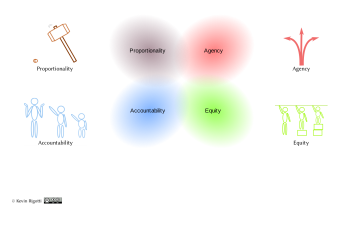
The preparatory step is to identify what matters to you as a practitioner, your company as a product owner, and your prospective customers as purchasers and users of the product. As this is an ethically focussed method, these are the ethical properties that the design should have, that distinguish a "good" design that provides a trusted transparent collaboration with the user, from a "bad" design that does not.
Step One
The first analysis step is to identify which of the desirable properties relevant to your product or service might be vulnerable in a way that creates a precarious situation for the user, namely a jeopardy. The scope of the property should be within the influence of the design, but need not be within the system boundaries and need not be vulnerable in all circumstances or for all users. The vulnerability should be foreseable given the known or suspected limitations of the user research and design activity so far. The aim is a qualitative analysis, not a quantitative assessment of the numbers affected or the tolerability of the potential harms caused if the vulnerable property is actually compromised or lost.
Step Two
The second step is to identify evocative words, phrases, images, or objects from the domain of the design that provoke a creative response to the vulnerable property. Each provocation starts a conversation about the problem and helps communicate it to the team.
Step Three
Step three is to iterate over all the vulnerable properties, supported by their provocations, to identfy if there is a potential issue. If there is, the team discuss it, and decide if it should be confirmed as a threat to a desirable property that needs to be captured as a new jeopardy to monitor and mitigate, or added to the description of an existing jeopardy, or discarded as a broadly tolerable nuisance that requires no further action beyond your normal user support process. The focus of the discussion should alternate between the property, and the causes of its vulnerability, and the people affected by it, swapping between people and property as many times as needed to achieve a shared understanding.
Step Four
Step four of the method is to structure all of the discussion from the previous step into a visualisation of the problems identified. It is quite likely this will prompt further discussion and possibly useful insights into the reasons and mechanisms, so some iteration may be needed. One suitable visualisation would be a bowtie diagram.
Step Five
The final step is to communicate the findings to everyone who needs them. This should be in a form they can use through the product life-cycle, and extend and update as new information comes to light.
Why use jeopardy analysis
Jeopardy analysis can help you to manage your decision latency trade-offs. The time from making a problem visible to committing to a response needs to be balanced with the cognitive burden of the decision. Driving ever shorter decision times may simply destroy confidence in your choices and lead to premature committment, before you know enough about the problem. You may be able to anticipate a vulnerabilty to a problem well ahead of having sufficient experience of it to fully understand it or design mitigations to it.
The visualisations you build from your jeopardy analysis provide placeholders for decisions you are not ready to make yet, and a place to ask important questions about them. How reversible is it? What impact on people and systems will it have? How much coordination will it need? How confident are we now compared to the confidence we need? Will we know more later?
By ensuring that the right person has the right data at the right time to make the right decision, jeopardy analysis can help you stop your user research surprises becoming business shocks.
Further information and examples
Practitioner friendly technical papers, and worked examples are in production.